

You’ve probably noticed the World Cup craze all around you. Hard charging, fast, highly focussed and skilled, the “football” players on the soccer field competing internationally aren’t only bringing out the fervor among the players, but the fans as well.
Graduation celebrations also still abound, and touching many thousands of family members across the education continuum.
So perhaps just perhaps, that’s why one of the biggest education stories of the year slipped past the headlines this week.
Actually, it wasn’t one story.
It was a collection of stories that, when connected, provide a remarkably discouraging picture of how education is doing in this country.
Let’s connect the dots though some of the many voices and data points revealed this past week.
Lies, Lies and Statistics
A day after the The New York Times ran a story on the new federal scholarship tax credit program, the National Assessment of Educational Progress (NAEP) released its long term trend results, once again revealing how poorly US students perform.
In many ways, it helps explain why families continue to seek new educational opportunities and why debates over school choice, vouchers, tax credits, and scholarships continue to resonate, something the article would have been useful to point out, rather than making it political.
According to NAEP:
“The average scores for 13-year-olds declined 4 points in reading and 9 points in mathematics compared to the previous assessment administered during the 2019–20 school year. Compared to a decade ago, the average scores declined 7 points in reading and 14 points in mathematics.”
The news was even more troubling for historically underserved students.
“In mathematics, the 11-point score decrease for female students compared to the 7-point decrease for male students resulted in a widening of the Male−Female score gap in comparison to 2020. Also, the 13-point score decrease among Black students compared to the 6-point decrease among White students resulted in a widening of the White−Black score gap from 35 points in 2020 to 42 points in 2023.”
With bittersweet kudos to Marc Porter Magee, founder and CEO of 50CAN, the following chart shows what effectively erasing roughly three decades of academic progress looks like:
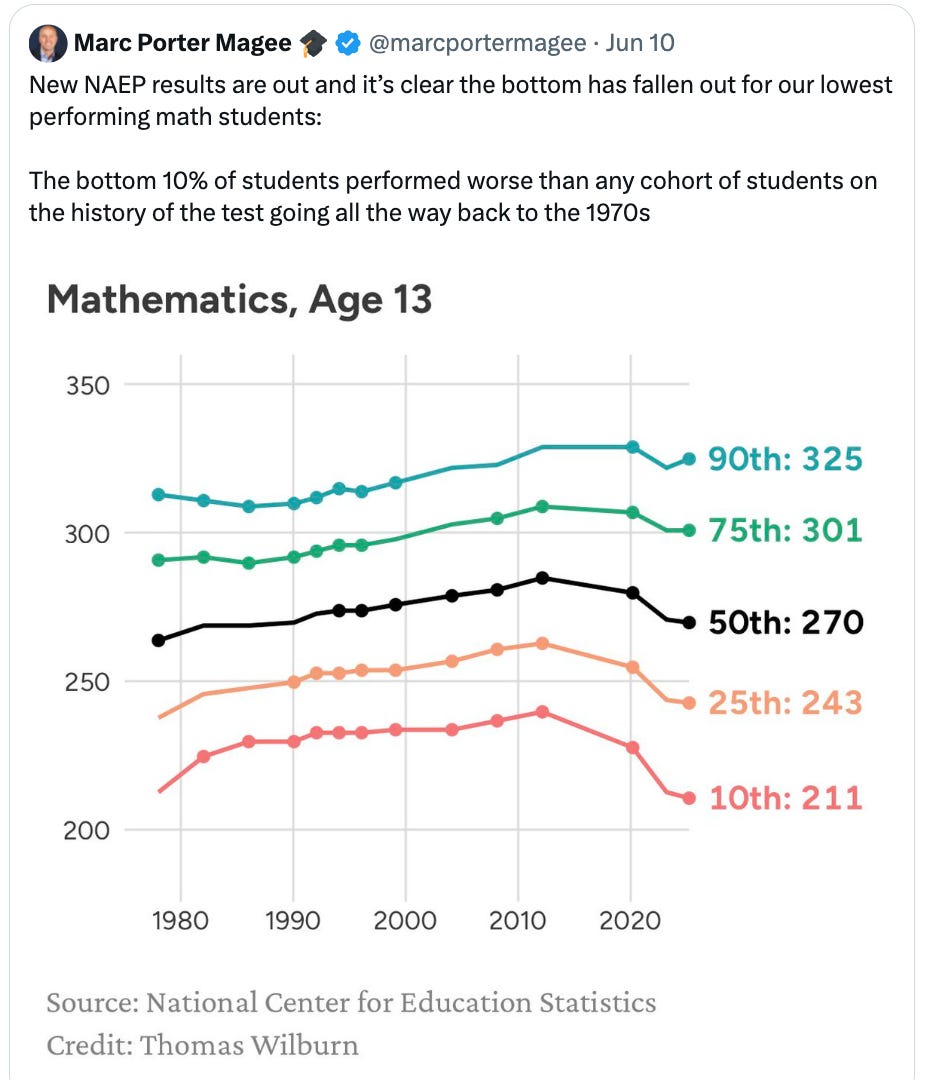
Marc summarized the results this way:
“We’ve never seen drops in achievement like this before. It’s basically a loss of a year and a half of knowledge per child and a reversal of three and a half decades of steady progress. The system isn’t designed to fix the scale of the problem. And the problem isn’t being fixed.”
Not a Voucher
The day after the New York Times piece, the Treasury released guidance confirmed that regulations for the new tax credit are forthcoming in September as are hopefully approval from some Blue State governors who might soon realize this is about giving all taxpayers a chance to contribute the kind of education they believe most needs their support.

Even acknowledged choice critic and pro-teachers’ union education professor Josh Cowen acknowledged that, because public schools can also participate “almost every governor would eventually choose to participate in the program.”
“‘In what world would closing the door to new revenue make any sense?’” he asked.
Teachers Unprepared And…
There are two equally important issues going on that were also revealed this past week to little fanfare.
The National Council on Teacher Quality (NCTQ)’s latest report pretty much identified the culprit to declining achievement.
Nearly half (47%) of the teacher preparation programs NCTQ reviewed fell short on at least one core component of scientifically based reading instruction. One in five programs (21%) earned an F—meaning they taught only one, or none, of the five essential components of reading instruction. Twenty percent of teachers(I’d venture to guess it’s more) still teach methods that run contrary to reading science research.
Programs that declined to participate in the review were disproportionately low-performing, with 61% of previously reviewed nonparticipants having earned an F.
“Failing to prepare future teachers to teach reading well is a form of educational malpractice against future teachers and the students they’ll serve. Half of teacher prep programs are doing the work. The other half needs to catch up fast,” said NCTQ President Dr. Heather Peske.
No wonder 40% percent of fourth graders—more than 1.4 million children—cannot read at even a basic level.
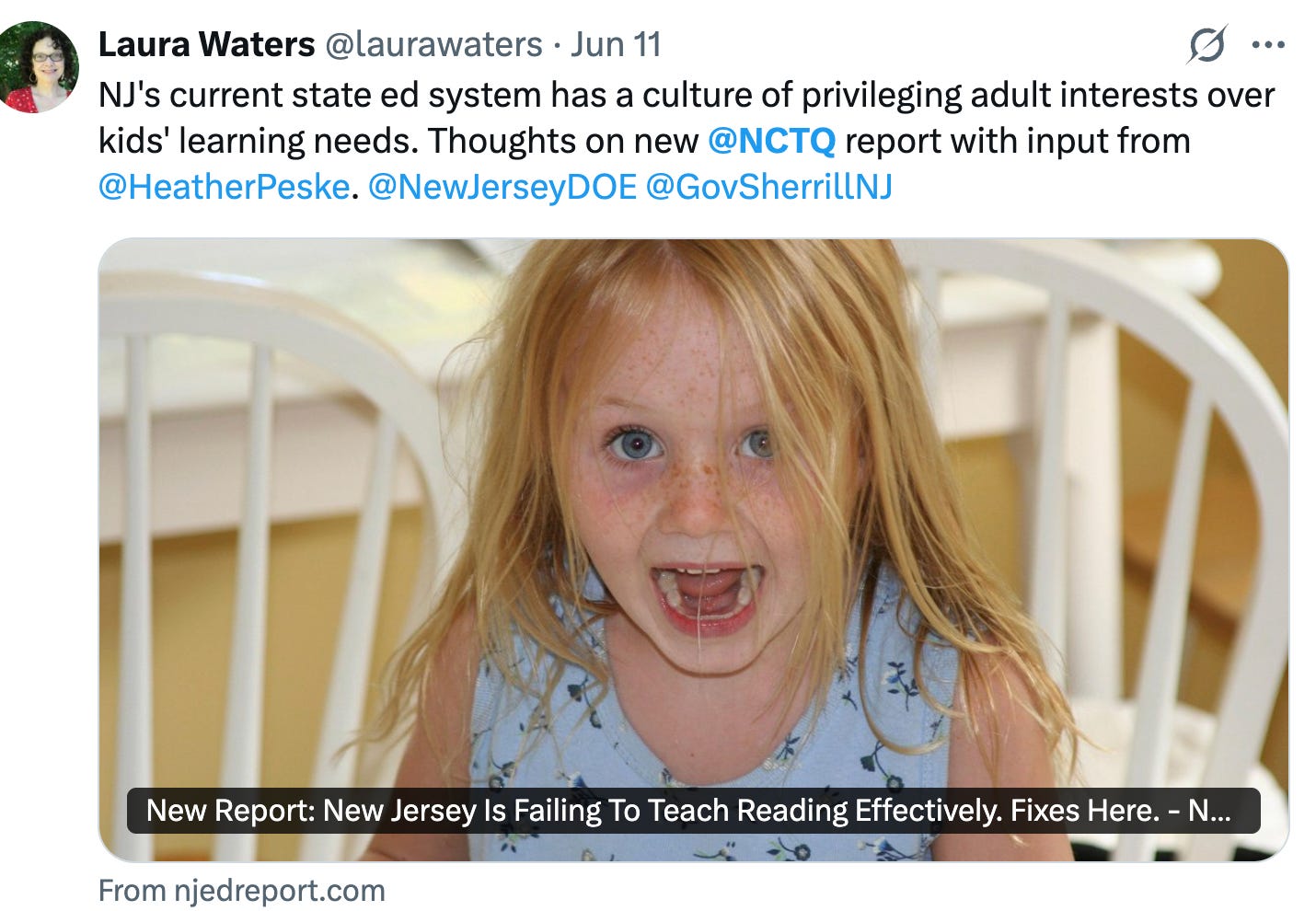
New Jersey offers a particularly vivid example with 54% percent of its teacher preparation programs receiving failing grades from NCTQ.
Question: If credentials equal preparation, why are outcomes moving in the wrong direction?
…Told to Lie?
The same week The Philadelphia Inquirer reported teachers admitting to an age old practice in failing districts — being pressured to pass students who rarely attend class, complete little work, or fail to demonstrate mastery of the material.
The article says teachers describe it as an “open secret,” making it “impossible to fail.” I’d suggest a better description—FRAUD.
Failing schools, closing schools and giving students new opportunities need to go hand in hand. Check out OpportunityKnocksPhilly.org.

It All Adds Up…Kids Don’t Read Anymore
NAEP also found that only 14 percent of 13-year-olds report reading for fun almost every day. A generation ago, that figure was more than twice as high. Among 9-year-olds, daily reading for pleasure has fallen from nearly 60 percent to 37 percent.
Three decades of giving students pablum for reading—“newly” developed books and stories designed to make one feel good rather than read well—while sidelining millions of original texts that challenge one’s understanding of life and contain more words than most students will ever know today, has resulted in boredom with reading.
Tom Loveless, longtime Brookings scholar and a leading scholar on student achievement, highlighted another NAEP finding: the homework gap. It explains a lot.
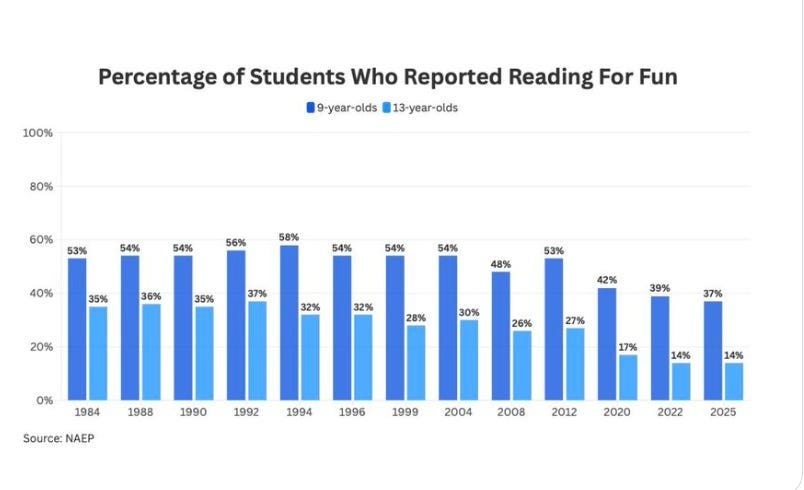
“All NAEP surveys show homework falling over last 2 decades,” says Dr. Loveless.
In 2000, only 2 percent of 8th-grade math teachers reported assigning no homework. By 2024, that figure had risen to 22 percent.
Obviously students have come to believe—or be told—it’s not important.
Washington to the Rescue?
I know. It’s a contradiction in terms. But the latest effort by HELP Committee Chairman Senator Bill Cassidy of Louisiana may help. Alarmed by the consistent failures, he introduced a major literacy initiative, with bipartisan support, to encourage states to adopt evidence-based reading instruction rooted in the science of reading, strengthen early literacy screening, and provide support for students with dyslexia.
“Education changed my life,” he said. “reading is the kernel within education that makes it work.”
Go for the Goal
If you graduated, watched a graduation, or simply saw signs on front lawns hailing the local graduate, you know what an awesome time of year this is.
Congratulations to everyone who has been part of a graduate’s journey—as a parent, grandparent, family member, educator, friend, school leader, or community member. Few times of year are as nostalgic as graduation season.
Some of my fondest memories are helping my kids navigate all the twists and turns that come with growing up, and then looking ahead to what summer might bring. Graduation season reminds us how quickly it all goes by.
But come on. It’s not really about the ceremony. It’s about what the ceremony represents.
Or at least it should be.
As this week’s data reminded us, for far too many students, a diploma does not necessarily represent mastery of the knowledge and skills they need to succeed in life.
So continue to enjoy the parties. Eat the cake. Take the pictures. Cheer loudly.
Then, when you have a quiet moment, ask yourself what we want that diploma to mean.
Here’s to hard work - Jeanne