
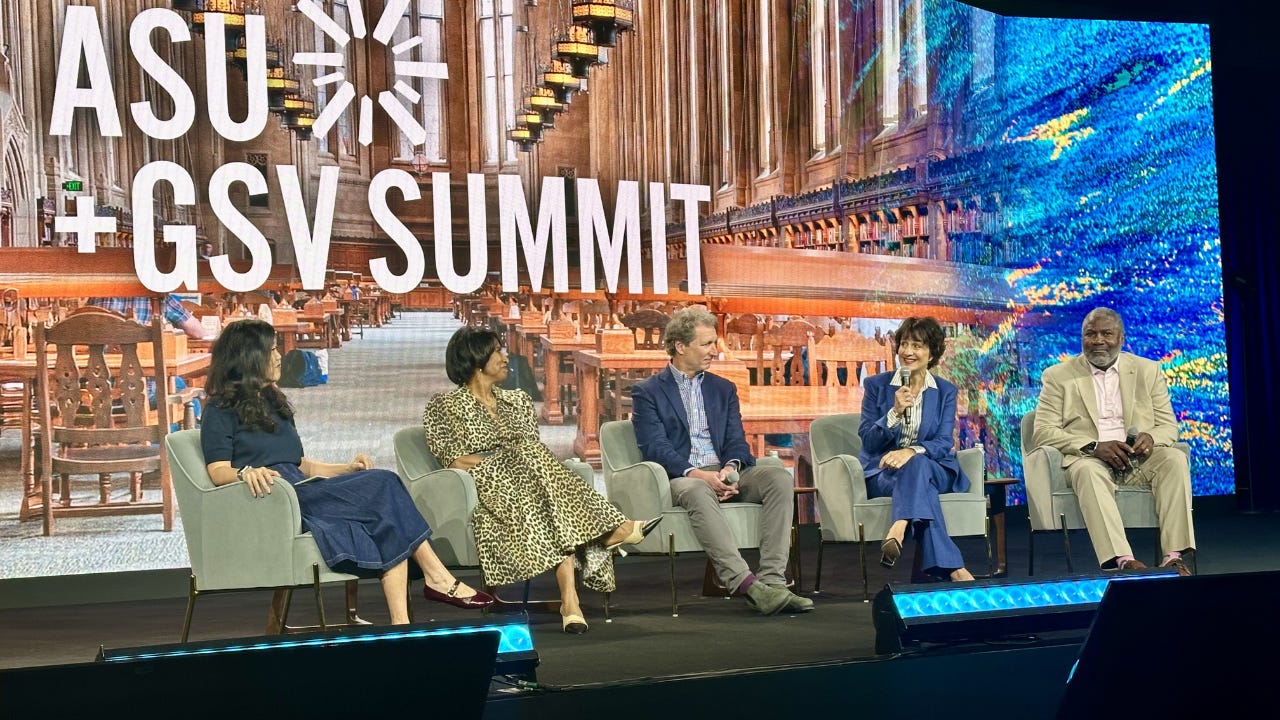
After three days on the ground at the #ASU+GSVSummit in San Diego, one thing came into sharp focus: education technology—now centered on artificial intelligence—and education choice are no longer separate issues. They are converging forces, driving one another into further expansion, reshaping the education landscape in real time.
At its core, this moment is about freedom—expanded access, customization, and control. But even the most enthusiastic technologists acknowledge the need for guardrails to preserve what matters most: human interaction.
We listened everywhere—on stage, in hallway conversations, and through our own “person-on-the-street” interviews—asking what drives people, how they see innovation, and who is doing the most important work.
Three themes dominated:
AI and education are now inseparable.
Specifically, education choice. As the surge—almost a flood—of new AI-driven products and services aim to transform everything from administration and operations to teaching, learning, and public access, teachers, schools and parents are forced to become more discerning consumers. They are navigating a plethora of products that claim to be able to ground students in the best and most individualized of educations, improve outcomes, streamline systems and more.
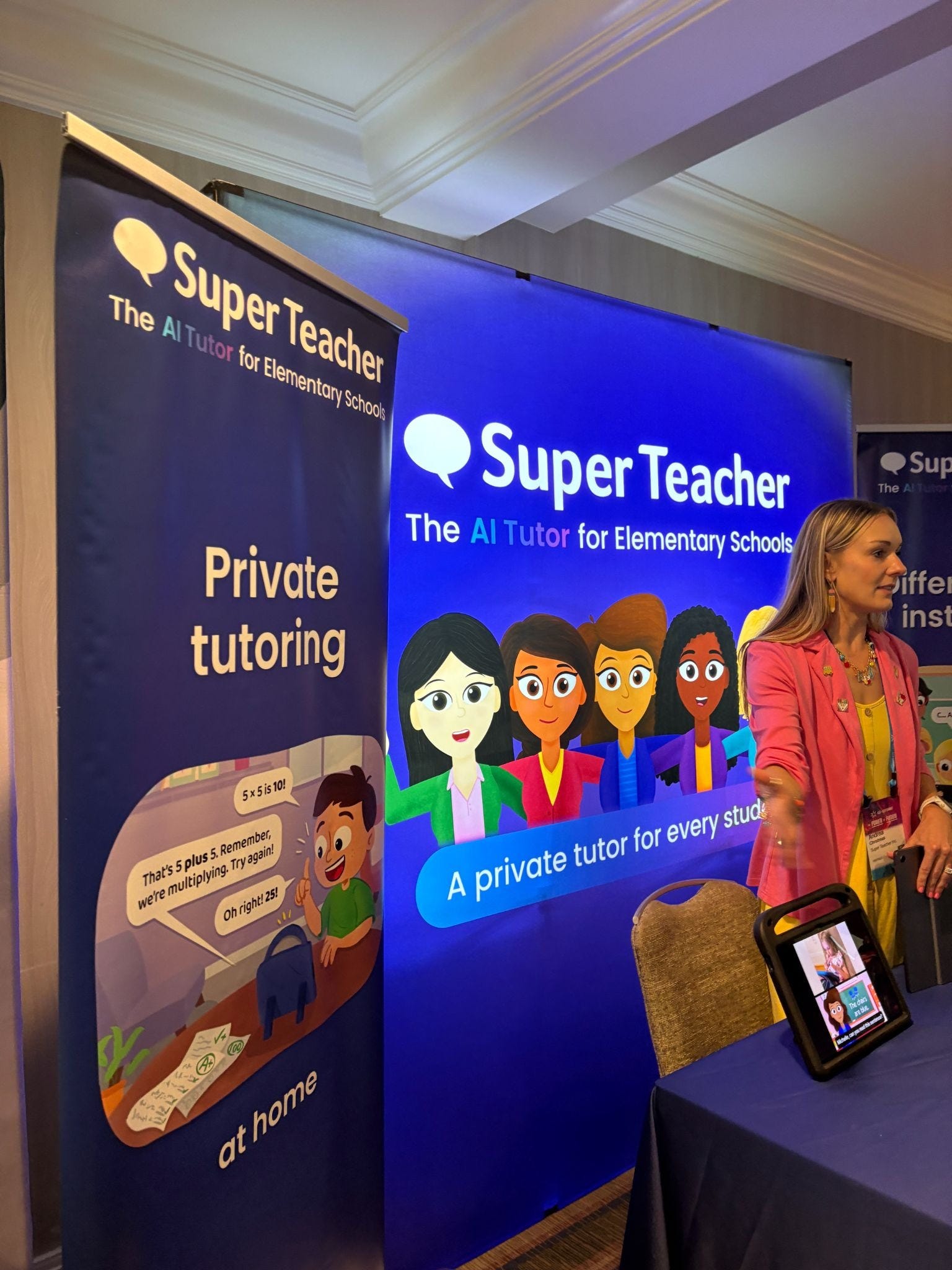
Central to every conversation regardless of education sector was how these tools actually get used, where they deliver real value, and how to bring clarity to a space expanding faster than most can track.
That concern surfaced repeatedly in discussions about OpenAI, Anthropic (which the Free Press’ Nellie Bowles suggested could become more powerful than government), and dozens of new products and services from emerging companies, schools, and major incumbents including Google, Meta, and Microsoft.
For those of us who care about knowledge, however, the central question is whether their tools will deepen learning or will be a lazy substitute for what students should know and be able to do by providing immediate answers?
Veteran education journalist Greg Toppo raised questions about the role of human interaction alongside AI. We’ve captured his perspective— and dozens of others—in a forthcoming podcast).
AEI’s Rick Hess questioned the extent to which tools are being confused with education, noting that what education needs in an AI world is what it has always needed: knowledge.
Organizations focused on expanding student knowledge are using AI to prompt inquiry and reinforce content rather than provide answers, aligning more closely with a Socratic model that requires students to think and engage. Variations of this approach are beginning to take hold not only in the U.S., but internationally.
As I write, I’m en route to Rome for the Ingenium Education International Schools conference, where I will be speaking alongside former Italian Education Minister Lorenzo Fioramonti. Together they are advancing evolutionary AI, reinforcing and expanding student access to knowledge, not replacing it.
Education choice has reached a political tipping point.
A parallel track was aptly-named “Multiple Choice” world, a place where customizable education is within everyone’s reach.
In an audience that typically tips progressive, the broad embrace of this concept across sectors and ideologies made it clear to many more—education choice is no longer taboo. What’s becoming radical is the opposite: resisting the personalized pathways that education choice promises—whether through products and services that parents can access with ESAs or through programs that enable families to build more customized experiences.
Just look at education entrepreneur and freedom advocate Erika Donalds, who is building services to translate and connect opportunities across state lines, in the same room as Blue state Rhode Island superintendent Angélica Infante-Green, who is actively seeking to protect and advance her state’s charter school law and has expressed interesting to opting in to the federal scholarship tax credit. She—and a growing number of state education leaders—are now part of the solution, where they were once seen as obstacles.
With roughly 25 percent of students now outside traditional public systems by choice—and many more exercising choice within them—the old monopoly is steadily eroding. What once dominated the conversation no longer defines it.
It used to be taboo. No more.
Welcome to 2026—a fitting moment as we approach a year celebrating freedom.
I had an absolute blast on the opening plenary session, alongside pioneers Michelle Rhee, Kevin Hall, Phyllis Lockett, and Ian Rowe. Taking on the topic, Multiple Choice: What’s Love Got to Do With It, we all agreed that—while obstacles remain and some cities are antagonistic, the politics are more fully tipping and choice love is in the air.
.

Tax day looms large for us all this week. Just imagine if the tax credit scholarship is adopted in every state, giving more families a chance at a real life and their fullest potential. I wrote about that in Forbes this week. Let me know what you think.
Human flourishing is the through line.
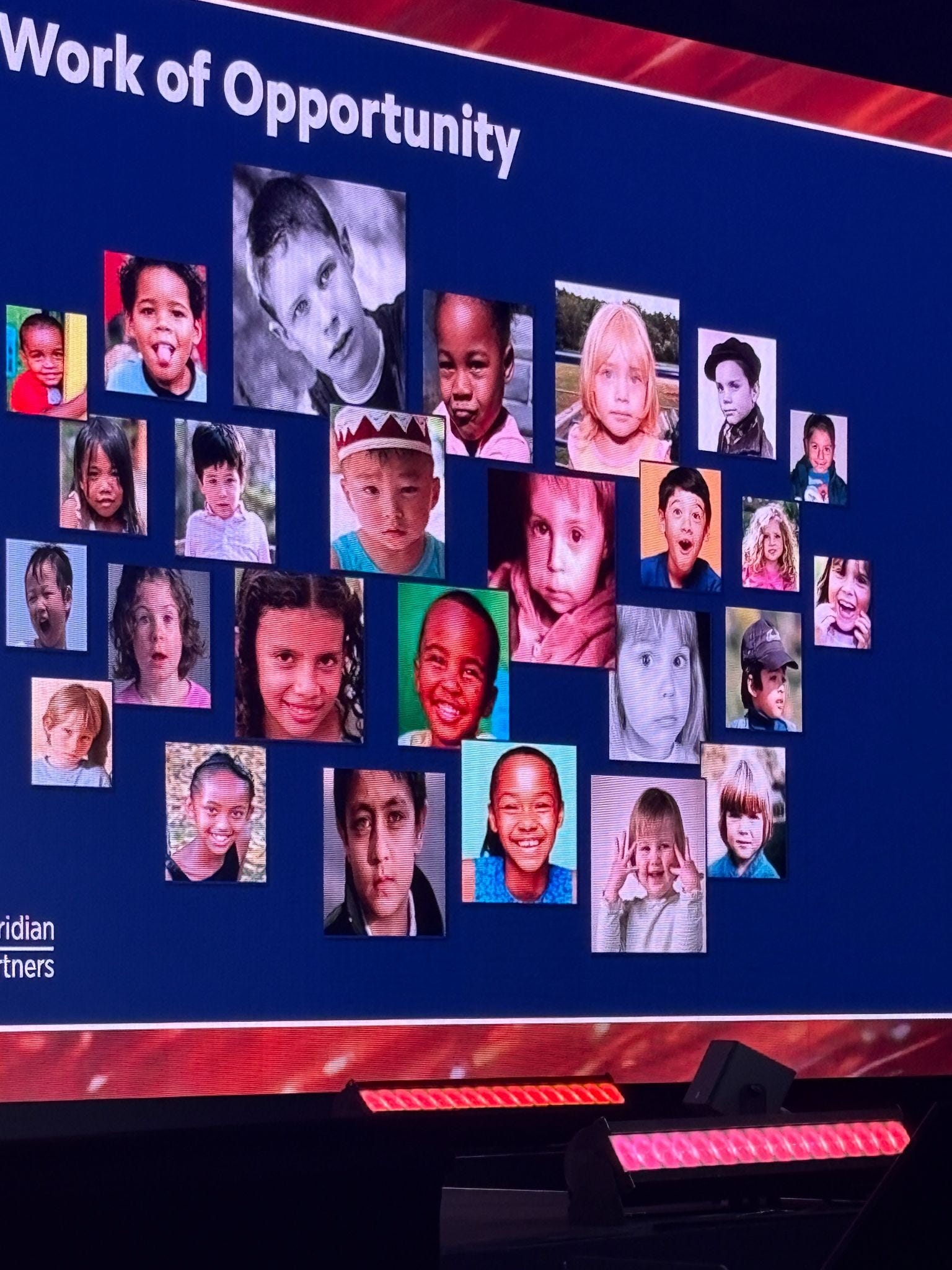
Outside of the technology conversations, the depth of focus on human development carried through nearly every interaction. It’s not just when talking about why everyone from CEOs to school leaders return—they continue to attend, time and time again to see people, to reconnect, and to support one another—but how we ensure learning builds good, thoughtful and civic minded people.
In hallway conversations, dinners, and receptions, the range of people shaping one another’s pathways—as well as the direction of education—is growing.
The presence of voices from Netflix founder Reed Hastings to superstar Goldie Hawn added to it all. In Goldie’s case, her MindUP program, now in thousands of schools internationally, focuses on helping students and teachers understand how the brain works so learning can actually happen. As she noted, drawing from Plato, you need to understand yourself before you can learn anything else.
The Yass Prize community reflected that same arc. Finalists and contenders from prior years were out in force, learning from one another, forming new collaborations, identifying tools and supports, and developing plans to expand their work. What is visible is not just individual success, but a growing network committed to helping students succeed and flourish.
There were also tons of incredible women CEOs gathering at various confabs, reinforcing each other’s strengths and opportunities to rise. A shout out to Erin Mote, Kelly Fuller, Vanessa Webb, Anna Edwards, Julie Young, Julia Rosen and Deborah Quazzo who are always present and thoughtfully engaged in enhancing what should always be humanly-inspired business and education, and who frankly make it a whole heck of a lot of fun to be around. That energy shapes the field in ways formal sessions cannot.
Relationships matter. They are the basis of human flourishing, which was on display all week.
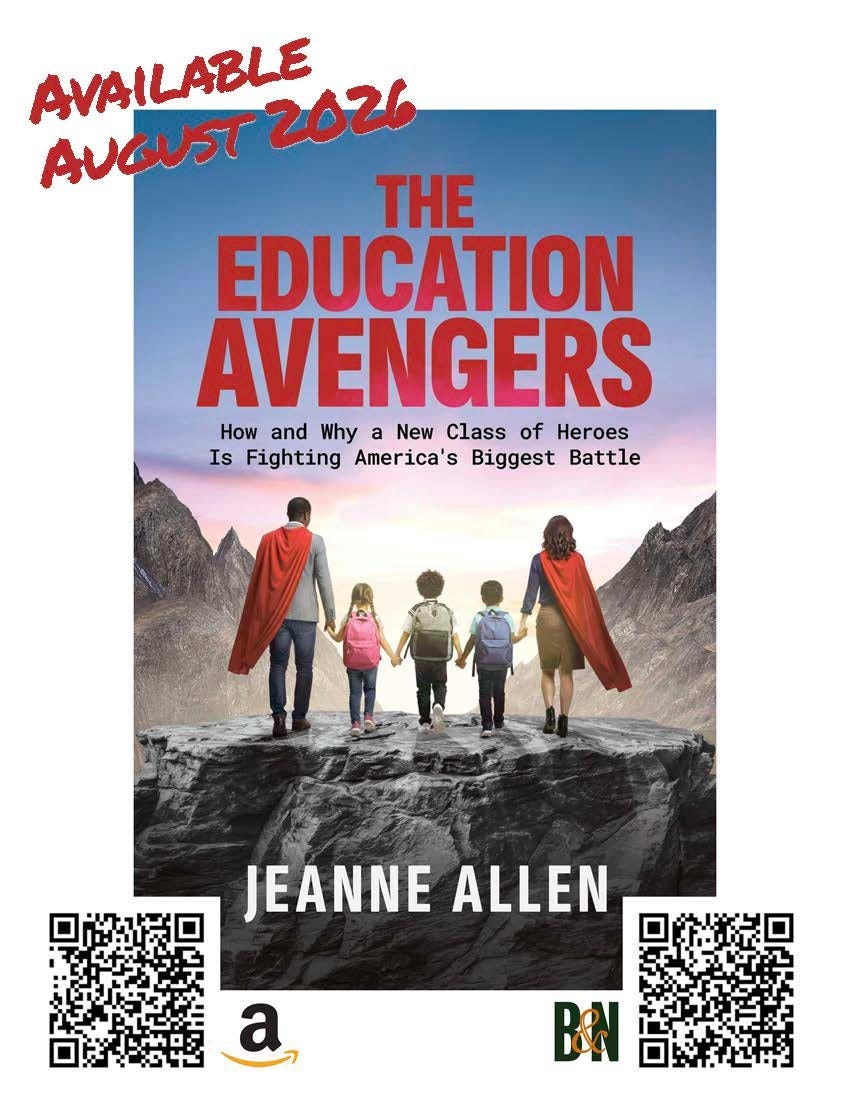
It is also the through line of my forthcoming book (!!), The Education Avengers, now available for pre-sale, which explores how individuals create the conditions for young people to succeed, belong, and flourish. I can’t wait for you to read it! (But order it first!)
Till next time — Jeanne
As a practicing classroom teacher, I find the statement that people are confusing tools with education surprising. How could they be confused? Why is it happening? And what does the confusion lead to?
Great article in Forbes. Thank you for getting the word out about the Federal Tax Credit Scholarship Program! One small note is that the program starts in 2027. The article states that it began in 2026.