

Just leaving Denver, where I was with extraordinary leaders, advocates, and supporters of educational opportunity in Colorado who—more than 25 years ago—launched the ACE Scholarships program. They did so after poorly litigated laws failed to reflect a constitutional right: that full and fair funding should be directed by families’ to their education preferences, not the status quo.
That this has been a fight for 20, 30, even 50 years in some states is, in many ways, a condemnation—of policymakers, of institutions, and yes, at times, of the broader ecosystem that has allowed inequity to persist. But it is also an opportunity. Because no one wakes up in the morning wanting worse for children. What they do is accept what is familiar. A system more than a century old—indeed, with roots stretching back far longer—becomes embedded in daily life, difficult to question, even harder to change.
But not anymore.
With determination and persistence, ACE Scholarships grew from one state to many—Montana, Louisiana, Kansas, Wyoming, Texas, Arkansas, New Mexico, Mississippi, and now Hawaii. At the time those efforts began, most of these states had little to no meaningful school choice. Today, they look very different.
Montana became a national touchstone through the Espinoza v. Montana Department of Revenue decision. Louisiana expanded its scholarship offerings. Wyoming enacted a model scholarship program. Texas has catapulted education choice to the forefront. Arkansas and Utah have expanded options, while Mississippi tries.
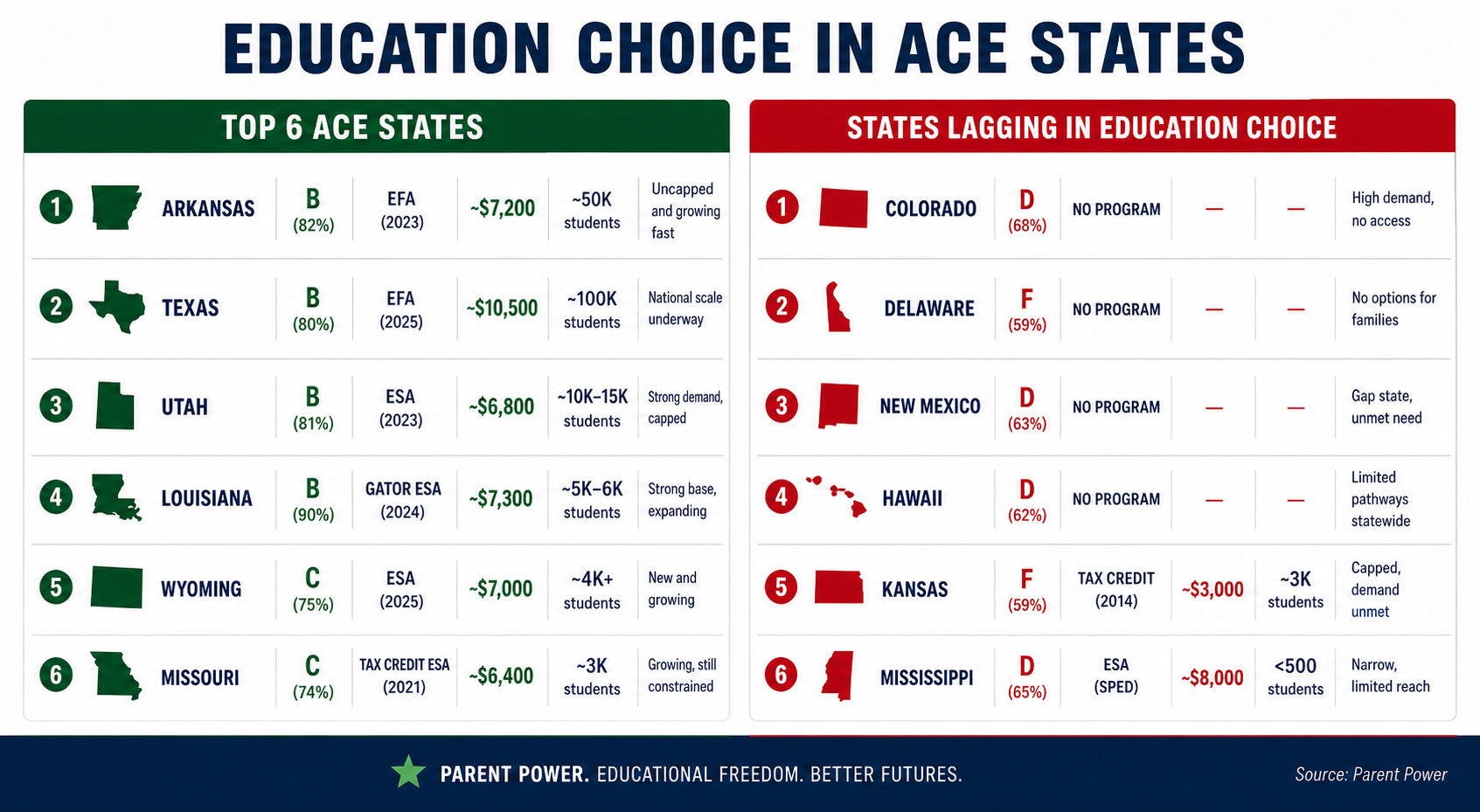
These efforts did not happen overnight. They took years—sometimes decades—of sustained effort. But what begins at zero does not stay there.
And now, with the emergence of the Federal Tax Credit Scholarship—one that requires states to opt in—states like Colorado have a real opportunity to expand options for students. But they must choose to act. States are not inherently “red” or “blue” when it comes to children. They are either responsive to families—or they are not. If yours is not one of the 27 that have opted in, it’s time. And even then, there is more to do.
The upcoming 2026 Parent Power Index,, to be released June 15, will make that even clearer. Kudos to ACE—for today’s event, yesterday’s work, and tomorrow’s continued commitment.
Cultural Literacy—or Screens?
Speaking of education, we can never forget that content matters. This is something classical schools discovered long ago.
Whether learning is delivered in person, hybrid, through artificial intelligence, or in any other form, content matters. Books matter. Original texts, preferably.
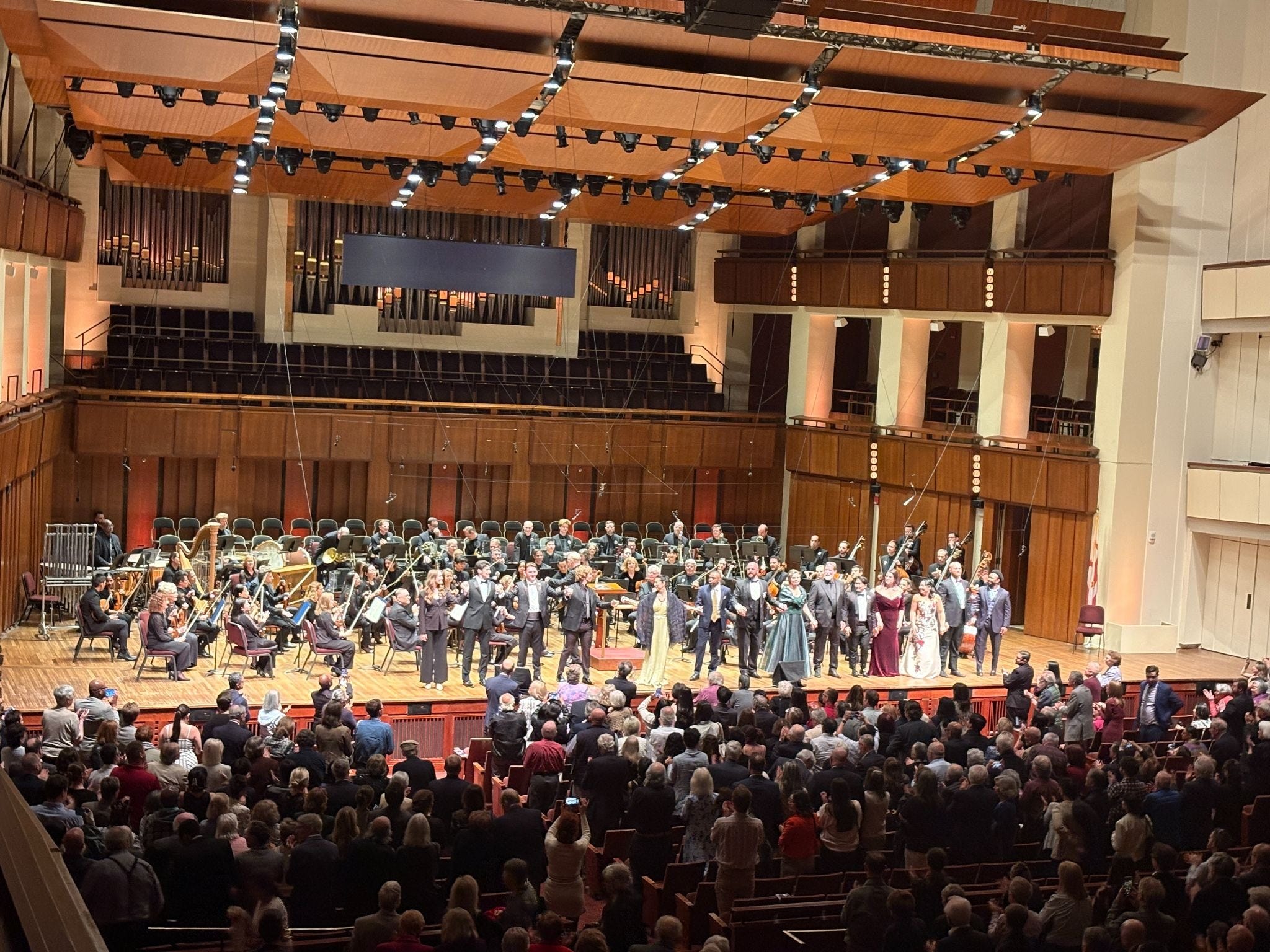
I was reminded of that recently attending Il Trittico—three operas by Giacomo Puccini. I am still learning what it all means, but what is unmistakable is how deeply the stories engage, amuse, and devastate—bringing together tragedy and humor, love and loss, all at once.
These are distinctly human experiences. Talking about them, writing about them, understanding them—this is what education once did.
Aside from math and science, which train the mind to think, art, culture, history, and civics train the mind to understand.
E.D. Hirsch Jr. famously argued in Cultural Literacy, “the more you know, the more you can learn.” Hirsch—hardly a conservative critic, but a progressive who was alarmed by the inequities he saw—came to a simple but profound conclusion: when schools fail to provide shared knowledge, they do not level the playing field; they widen the gap. Students who come from knowledge-rich environments continue to advance, while those who depend on schools for that foundation are left behind.
I also had the opportunity last week to attend a concert at the school my children once attended—thanks to my husband, who directs music there. One piece in particular, Isle of Hope, Isle Tears, reflects the immigration experience so many families have lived through. Students were not just performing; they were interpreting, enacting, and bringing to life moments of history—learning them in the process.
It was a reminder that education comes in many different forms. That music and the arts can teach history, culture, and human experience all at once—often more powerfully than any textbook alone.
And that understanding matters—not only for intellectual development, but for the formation of people capable of contributing meaningfully to society.
Students with sustained engagement in the arts demonstrate stronger academic outcomes and higher levels of civic participation. Music training is associated with improved memory, attention, and language development. Exposure to cultural institutions increases critical thinking and empathy.
At the same time, excessive screen exposure—particularly without the counterbalance of reading, writing, and dialogue—is associated with reduced attention span, lower well-being, and diminished capacity for deep comprehension (See American Academy of Pediatrics; JAMA Pediatrics; OECD).
These are not minor tradeoffs. They shape how the brain develops and how individuals engage with the world.
As Former Education Secretary Bill Bennett has said, it all matters—content, character, and choice.
Do we want mediocrity or excellence?
More than four decades ago, the A Nation at Risk report warned of a “rising tide of mediocrity.” Its critique was clear: expectations too low, curriculum too shallow. Mile wide. Inch deep.
Reforms followed. And over time, new kinds of schools emerged—many of which families are choosing today. But the core issue remains.
What are students actually being asked to learn? And is it worth showing up for?
Get Your Education—on Route 66
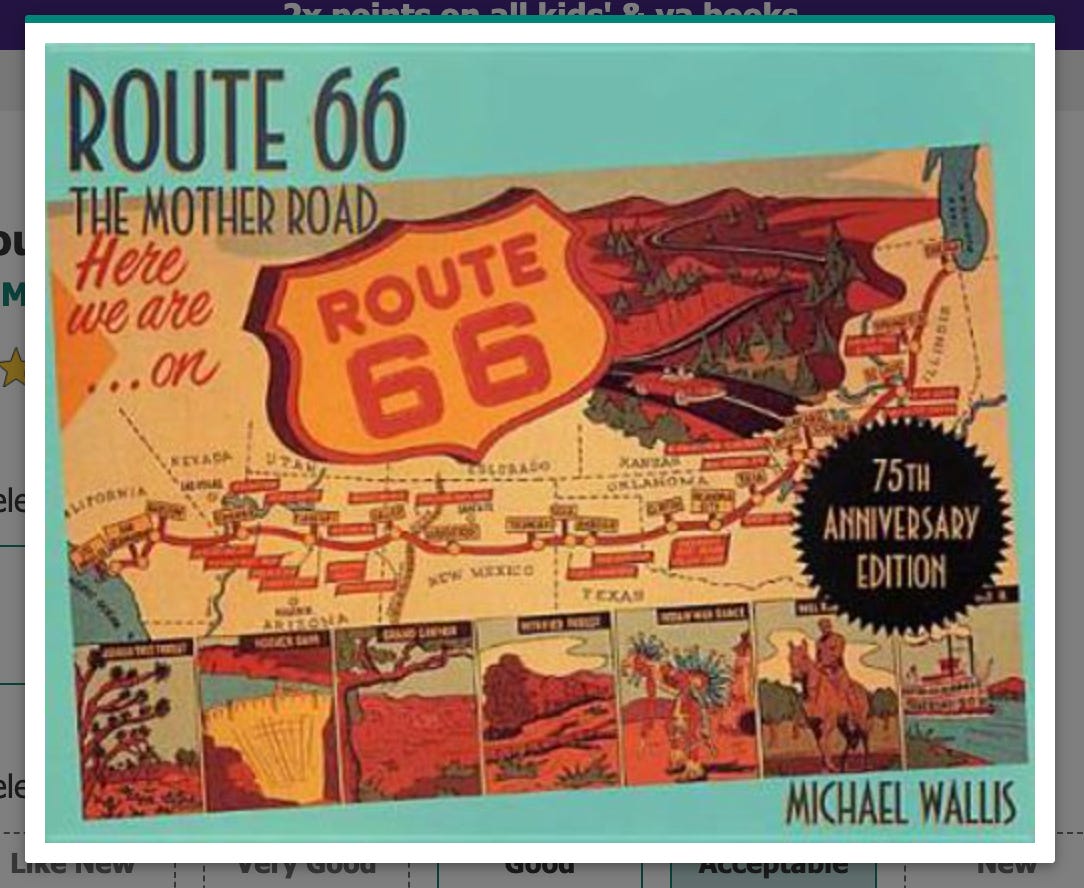
This year marks the approaching centennial of U.S. Route 66—the iconic road stretching from Chicago to Santa Monica.
For generations, Route 66 was not just a road. It was culture. It connected communities, carried stories, and became part of American identity.
Today, many Americans would struggle to locate it on a map, let alone understand its significance.
This is exactly the kind of gap E.D. Hirsch Jr. warned about. Literacy is not simply the ability to decode words—it is the ability to understand references, history, and shared culture. Without that foundation, a name like U.S. Route 66 is just a phrase, not a story. And without shared knowledge, even the most basic elements of our national experience become inaccessible.
This isn’t just a rant. It is a reflection on what happens when education loses its cultural core.
The Students Who Aren’t There
Another experience I had fuels my ire—and focus. I was with a cousin over the weekend who has spent 25 years teaching in one of New York City’s toughest schools. I asked her what has changed.
Her answer: attendance.
Students are simply not coming. They’ve left. Her class has gone from 28 students to 20. Among those still enrolled, on most days, only about 12 are there.
Some are at home. Some are working. Some have disengaged entirely.
Chronic absenteeism remains far above pre-pandemic levels nationwide, with many districts reporting rates of 20 to 30 percent or higher (U.S. Department of Education, 2024–2025).
Which brings us back to the question that should guide all of this.
What makes a student show up?
Aside from absenteeism, widespread under-enrollment is the symptom we should pay most attention to. Those kids who left the majority of the nation’s worst school systems leaving schools dramatically under-enrolled are going somewhere else—to schools that are full, often with waiting lists, where expectations are clearer and learning more coherent.
If when taught to read, students are given little worth reading—nothing true, nothing good, nothing beautiful— we should expect that they will move.
Students are not walking away from education.
They are walking away from what we have allowed it to become.
Education Frees Everyone
If we do not understand the problem, it is hard to find the solution.
Through empty seats, through disengaged students, through families making different choices—the nation is waking up every day with new awareness and determined to change the status quo.
They are working to ensure that more students are exposed to what it means to be truly well educated—the kind of child Deborah Kenndy writes about in her work, and the kind so many educators and leaders remain committed to forming.
Even those within the system want change. They want to be inspired to do things differently.
The states I mentioned earlier reflect that reality. They have had political shifts span different regions, different histories, different political leanings—and yet they have moved, over time, toward empowering families and recognizing that education improves when people are given the ability to act.
And the recognition that great education—education that builds knowledge, character, and opportunity—emerges when people are trusted and empowered to pursue it.
One commercial for just that before I sign off - Applications for the 2026 Yass Prize Application closes June 1. We need more great supply, not less. Share this now!
Here’s to an Isle of Hope for all our kids. - Jeanne