
A Time for Renewal and Resurrection

In the spirit of Easter and Passover, in this holy week, it is perhaps fitting to talk about a different kind of blessing—the potential blessing afforded to hundreds of thousands of students through a unique and, as of late, rare occurrence of bipartisanship.
It began with a provision in the Republican-driven “Big, Beautiful Bill” and was subsequently endorsed by prominent Democrats. Jorge Elorza, head of Democrats for Education Reform (DFER) penned an op-ed alongside former Obama Education Secretary Arne Duncan endorsing the very program Congressional Republicans—and the President—advanced to give children in states that do not typically create choice programs the opportunity to access them through private contributions to scholarship-granting organizations.
Yes, it’s a mouthful—but it’s worth understanding. If this is important enough for Democrats who have traditionally opposed education freedom to go out on a limb—and for Colorado Governor Jared Polis to lead the charge among governors opting in—then it is important enough for the rest of us to pay close attention and consider what comes next.
The political landscape is shifting quickly. In Wisconsin, Governor Tony Evers vetoed a tax-credit scholarship bill this month, blocking access for families. But in Kentucky and North Carolina, legislatures overrode gubernatorial opposition to move forward. Pressure is building in Illinois and New York, where leaders remain divided or hesitant. Meanwhile, Governor Polis was willing to break with most in his party by opting in and opening access for families—even as lawmakers in his own state pushed back.
By contrast, governors in Oregon, New Mexico, and Minnesota—including Tim Walz—have signaled opposition or reluctance, effectively keeping families from accessing the program, at least for now.
These decisions are unfolding in real time, with immediate consequences. What often gets lost in the political debate is this: taxpayers in every state are eligible for the federal tax credit, whether their governor opts in or not. The money will flow. The only question is where.
If a governor declines to opt in, families in that state gain nothing—they simply lose access. Their taxpayers can still contribute and receive the credit, but the resulting scholarships will go to students in states that chose to participate. In other words, opting out does not stop the program. It redirects its benefits elsewhere.
That’s not a policy stance. It’s a transfer—away from a state’s own children and toward others.
That is why the DFER leadership has argued that Democratic governors should opt in:
“It’s a chance to show voters that they’re willing to do what it takes to deliver for students and families, no matter where the ideas originate. By opting in, a governor unlocks these resources for students in their state. Some Democratic leaders have hesitated, however, worried that the program could be seen as undermining public schools, since private scholarships are also eligible.
But that misses the point. Opting in doesn’t take a single dollar from state education budgets. It simply opens the door to new, private donations, at no cost to taxpayers, that can support students in public and nonpublic settings alike. That’s why opting in isn’t just defensible; it’s a no-brainer.”
This is, in many ways, a moment of renewal—of resurrection, even—for an idea that has been debated, delayed, and dismissed for decades, now returning in a form that may finally reach the children it was always meant to serve.
Do Some Governors Hesitate Out of Ignorance?
It’s tempting to assume that when governors hesitate—especially governors like Maryland’s Wes Moore—it’s driven by ambition, politics, or calculation. That’s the easy explanation. It’s also not always the right one.
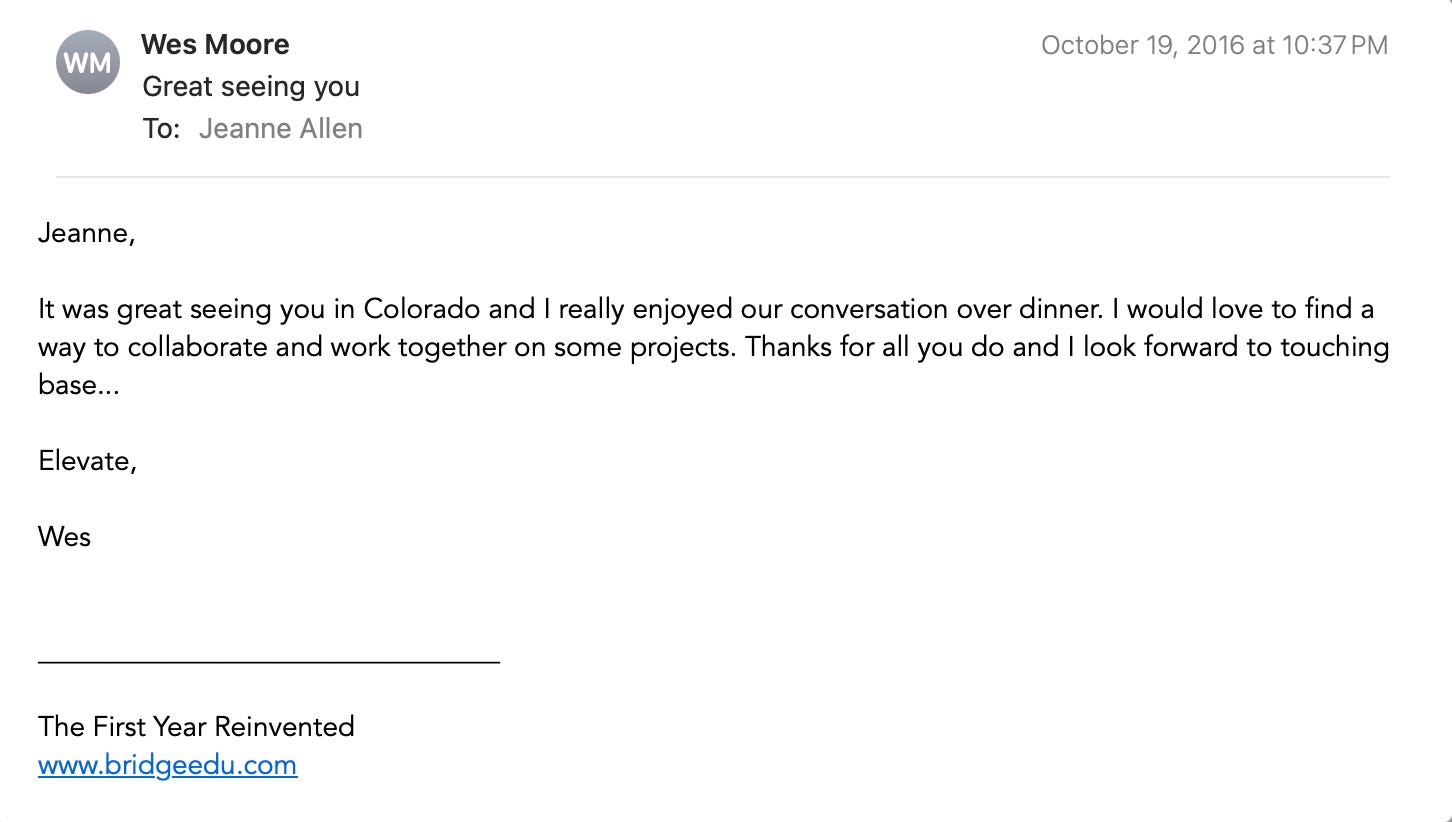
I had dinner with now-Governor Moore several years ago at an ASU+GSV gathering, not long after he published The Other Wes Moore. We were seated together, and I walked him through what we do. He was genuinely surprised—engaged, curious, even bordering on supportive of education choice. It wasn’t performative. It was real. He followed up. Several times.
Which is why what I’ve heard recently—that there’s “no way” he would ever opt in—doesn’t quite add up.
At the recent National Governors Association meeting, I asked him directly if he was reconsidering. He looked at me, puzzled, and said he had no idea what I was referring to. When I explained the federal tax credit scholarship program, his response was immediate: “That sounds amazing. Who should I talk to?”
I followed up with folks in the know afterward, only to be told, ‘Oh, he was just saying that to you.’ But that doesn’t track. He didn’t know the question I was asking.
Call me naïve, but I don’t think this is cynicism. I think it’s absence—of information, of exposure, and perhaps, intentionally, of perspective. Governors hear what their inner circle puts in front of them. And sometimes, what they’re not hearing matters just as much.
Because much of the hesitation we’re seeing—particularly among Democratic governors—is not rooted in the policy itself. It’s rooted in misunderstanding, in mistrust of who’s delivering the message, and in the political framing surrounding it.
And yet, the decision in front of them is remarkably simple: opt in, or don’t.
Opting in doesn’t require building a new bureaucracy or designing a new program from scratch. It simply means recognizing scholarship-granting organizations and allowing families in their state to access a benefit that already exists.
The complexity is political. The decision is not. Right, Wes?
Politics as Usual
Imagine living in a state where your child is not meeting his potential—Philadelphia, Boston, Chicago—where schools are struggling, enrollment is declining, and closures are becoming routine. And yet your governor refuses to act, not because the policy is flawed, but because Donald Trump supports it and the unions oppose it. That’s the practical absurdity in front of us.
Governors are responsible for all children in their states—not just those aligned with a particular political coalition. Refusing to opt in for political reasons, while taxpayers in your own state can still send resources elsewhere, is not strategy. It’s folly.
The Federal Tax Credit Scholarship is not a niche program. It’s a broad expansion of educational freedom—privately funded, family-directed, and widely accessible. Beginning in 2027, individuals can receive a dollar-for-dollar federal tax credit of up to $1,700—$3,400 for married couples—for contributions to approved scholarship-granting organizations. Nearly every K–12 student could benefit, but the greatest impact will be among families with the fewest options, especially those in traditional public schools. That’s why this debate matters—and why the politics surrounding it must be called out plainly.
There is some good news. Once final regulations are issued—as expected—several Democratic governors may move together rather than alone, opting in in close succession. The interest is there. What’s missing is timing and confidence.
But delay has consequences. Every day a state waits is another day its taxpayers’ dollars can flow elsewhere.
And with 36 governors heading into election cycles, choosing not to bring flexible education funding into their states—funding that can support both public and nonpublic school students—isn’t just a missed opportunity.
It’s political malpractice.
Public School Kids Benefit Most
And it is happening at a moment when nearly all K–12 students could benefit from this kind of flexibility. Traditional public school students, who make up the overwhelming share of the population though less than it used to be in before an increasing pluralist education world—about 76%—have the most to gain, says Invest in Ed’s Peter Murphy. The law allows scholarship-granting organizations significant flexibility in how funds are used, including for a range of education-related expenses that can support students in public schools as well. That is why this is, in many ways, the most expansive and, frankly, most progressive education funding mechanism we have seen, he says. It empowers parents, across sectors, to direct resources toward what their children need.
There are plenty of places to go deeper on the mechanics—including a map from the Invest in Education Foundation, the Parent Power! Index state leadership scores, or ED and Treasury’s fact sheet—but it is worth pausing to resolve the central confusion about what this program is and is not.

What It Actually Is—and Isn’t
The first and most important misunderstanding is the belief that this is some kind of national scholarship program. It is not. This program is state-based.
To make this concrete, imagine a CER scholarship-granting organization established in Washington, D.C. It could raise money from donors anywhere in the country, and those contributors would receive the federal tax credit. But the funds themselves would have to be used to support students in Washington, D.C. The more money these organizations raise, the more scholarships they can provide. It is not $1,700 per child. It is whatever the organization has the capacity to deliver.
Importantly, these organizations are not intended to operate around a single school or a narrow group of students. They are meant to serve students across multiple schools and communities, ensuring that the program expands access rather than concentrating it. That is not a technical detail—it is part of what the rulemaking is designed to ensure, so that what was intended in law is actually carried through in practice.
Another area where confusion has crept in is how the tax credit is actually claimed. This is not a separate system; it is part of your tax filing. You make the qualified contribution in a given year—on or before December 31—and in the following tax year you claim the credit the way you claim any other credit.
Let it Bloom

The bottom line is this program exists to ensure that students who live in places that do not provide choices have those choices, regardless of the political climate in which they live. Isn’t that a marvelous idea—to shield children and their choices and their futures from political bickering?
Remember, as I have always said, state programs matter. How strong charter school laws are, how strong ESA and scholarship programs are, whether full and fair funding follows children—all of that matters more than any of this. But in the absence of those conditions in every state, this is one of the most critical endeavors any policymaker, parent, or civic leader could embrace.
Happy Spring! The beautiful Cherry Blossoms may have peaked—but opportunity is blooming.
Happy Easter, Buona Pasqua, Chag Pesach Sameach…Blessings! - Jeanne

Our Governor Bob Ferguson - Washington - does only what the unions order and the Seattle establishment wants. He doesn't even read the state constitution. (Last week signed into law a state income tax despite the clear wording of our consitution and ten votes against.) But I will contact him.